How to Integrate ACT Into ABA Practice: A Starting Guide for Behavior Analysts
Last updated: September 2026
How to Integrate ACT Into ABA Practice:
A Starting Guide for Behavior Analysts
A behavior analyst's starting guide to integrating ACT into ABA practice: what it actually means, the six core processes in plain behavioral terms, and where to begin this week.
You've read the books. You've nodded along to the values work and the defusion metaphors, felt that click of recognition, and thought, "yes, this is the direction I want to practice in." And then Monday arrives, you are sitting with a real client and a real program, and you have no idea what to actually do differently.
If that is you, you are exactly where most behavior analysts stand when they first meet ACT. The gap between understanding ACT and integrating ACT into ABA practice is real, and almost nobody teaches the bridge.
Here is the short version. Integrating ACT is less about adding new techniques and more about a shift in how you assess and respond. You start by listening for what matters to the person and noticing patterns in how they respond when difficult thoughts, feelings, and situations show up. (First, a quick check: make sure it is within your [scope and competence].)
Below is what integration actually means, the six processes in plain behavioral terms, and a way to begin this week without abandoning your training or your data.
What does it actually mean to integrate ACT into ABA?
It means using ACT's six core processes as a lens that helps direct your behavior-analytic attention, not bolting a few exercises onto your existing programs. ACT, which stands for Acceptance and Commitment Therapy, or Training when it is used outside psychotherapy, is not a departure from behavior analysis. It grew out of it.
ACT organizes its work around psychological flexibility, an organizing concept for responding effectively and in line with what matters, even when difficult thoughts and feelings are present. For a behavior analyst, that gives us patterns worth investigating rather than another trait or thing inside the person.
[Tarbox, Szabo, and Aclan (2022)] make this case directly, mapping ACT onto the seven dimensions of ABA and the BACB task list. When I started, I assumed integration meant learning a toolkit, a set of exercises, and protocols. It does not. It means changing what you pay attention to.
Start with function, not techniques
The first move in integrating ACT is assessment, not intervention. The most common mistake is reaching for a defusion exercise before you understand what the behavior is doing for the person in front of you.
Defusion is an ACT term that directs attention to how thoughts and rules are influencing behavior. A defusion exercise can be useful. It can also be useless, or occasionally unhelpful, if you reach for it before understanding what is happening for the person in front of you.
So begin the way you already know how: by assessing function. Tools like the ACT Matrix can give you a structured way to listen for what matters, what shows up internally, and what the person does next. What you hear gives you places to investigate. It does not establish function. That shift, from rushing to fix behavior to slowing down and asking better functional questions, keeps the work behavior-analytic.
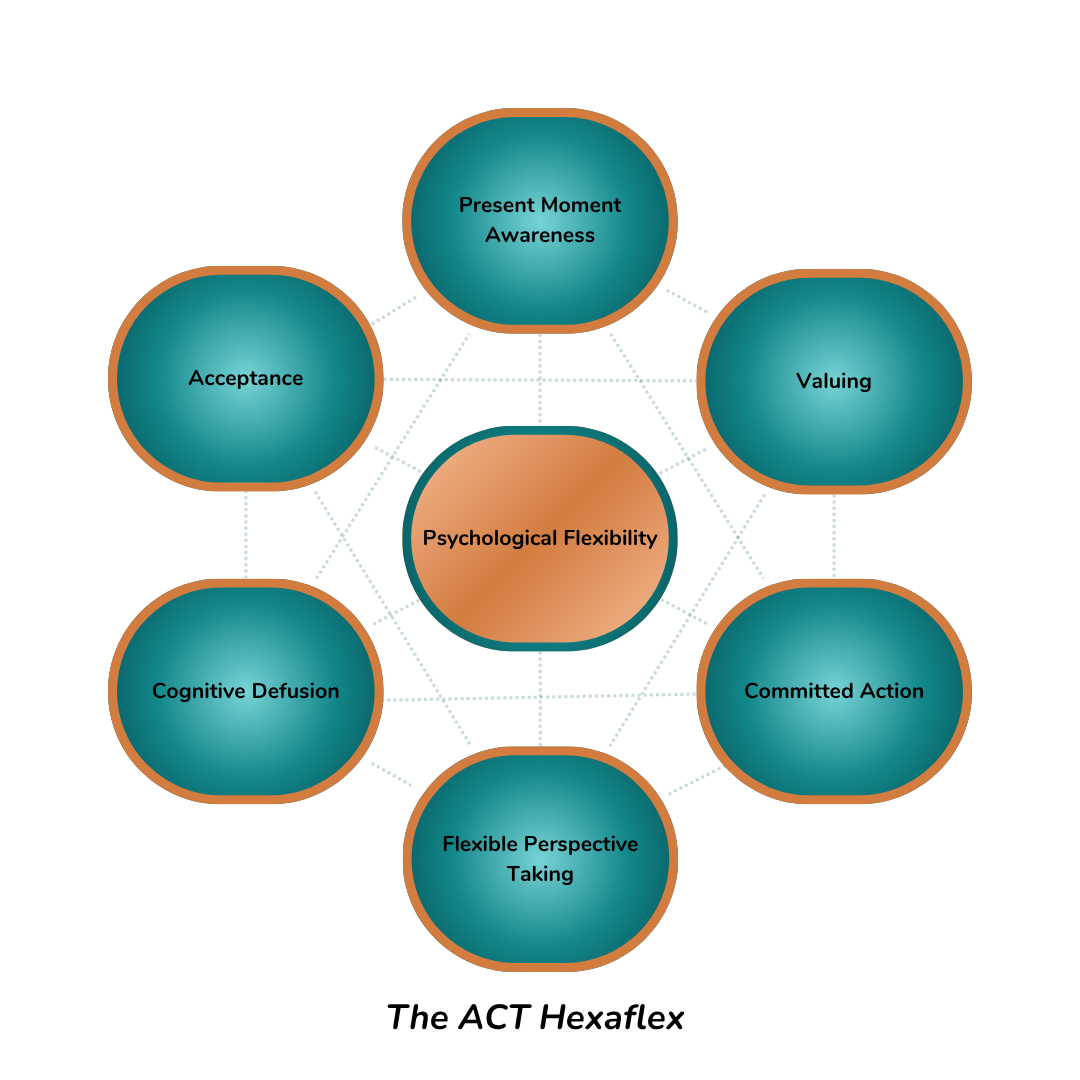
The six core ACT processes and what they may help you notice.
The traditional ACT model organizes psychological flexibility around six interconnected terms, often drawn as a hexagon called the hexaflex. These six terms can help direct your attention toward patterns worth exploring. They do not, by themselves, tell you the function of behavior.
ACT term | What it might orient you toward | What it can look like in your practice |
|---|---|---|
Acceptance | Escape and avoidance around difficult private events. What happens when those events show up, and what does the person do next? | A client experiences frustration or anxiety and continues taking a meaningful step. Get curious about what makes that possible here and what usually leads to avoidance. |
Defusion | Verbal control. How is a thought, rule, or other verbal stimulus influencing behavior? How sensitive is responding to what is happening in the current context? | A parent says, ‘I am failing.’ Rather than immediately reaching for a defusion exercise, listen for how that thought is influencing what they do. |
Present moment awareness | Attention to current environmental and private events. What is controlling responding right now: current contingencies, past learning, predictions, rules, or something else? | A client is worrying about what might happen tomorrow. Notice what is influencing their responding right now, including what is happening around them and the verbal events showing up. |
Flexible perspective taking | Perspective taking and deictic relational responding may be relevant here. Notice how the person relates to their own thoughts, feelings, experiences, and sense of self. | A client says, ‘I’m just an anxious person.’ Get curious about how they are relating to that description of themselves and what happens when they respond from that position. |
Values | Look at what gives behavior direction and meaning. How does language about what matters alter the reinforcing or punishing functions of actions and outcomes? | A client talks about being the kind of parent they want to be. Notice whether and how that language changes the significance of different actions available to them. |
Committed Action | Patterns of values-linked behavior shaped and maintained over time. What contingencies support or interfere with those patterns? | A client takes a small step toward something that matters to them. Notice what supports that behavior, what gets in the way, and what helps it continue over time. |
A simple way to begin this week
Pick one area of ACT to pay closer attention to with one client. Values is often an accessible place to start. Ask what matters to them and listen to how that language relates to the choices available to them. Then collaboratively identify one small step and observe what happens.
Integration fails when behavior analysts treat it as a full system rebuild instead of a single new habit of attention.
Where behavior analysts get stuck, and how to get unstuck
The usual sticking point is running ACT exercises you cannot analyze. When you choose an exercise because you have labeled the problem ‘fusion’ or ‘avoidance,’ rather than because your assessment gives you a reason to try it, ACT can turn into technique-matching instead of behavior analysis.
Three other common snags:
leaning on scripts instead of responding to the person in front of you,
moving too fast and overwhelming everyone, and
drifting from behavioral training toward something that looks more like psychotherapy, which is a [scope of practice] problem waiting to happen.
The way out of all four is the same. Return to function. Slow down. And when you hit the edge of your competence, get consultation or supervision rather than pressing on alone, which is exactly what the ethics code asks of you. Getting unstuck is not about knowing more exercises. It is about staying behavioral.
FAQs: integrating ACT into ABA
Q: Can BCBAs integrate ACT into ABA practice?
A: Yes, when ACT is used as behavioral training that targets socially significant behavior, and when you have documented competence in it. Integration is a matter of functional assessment and competence, not of learning the right exercises. Confirm it sits within your scope before you begin.
Q: Do I need to be certified in ACT to start?
A: There is no separate ACT certification required. However, BACB Ethics Code Standard 1.05 asks you to practice only within your competence, which means documented study, training, supervised experience, or consultation before you use ACT processes with the people you serve.
Q: How is ACT different from traditional ABA?
A: ACT is rooted in functional contextualism and behavior analysis, with particular attention to private events, verbal behavior, values, and flexible responding.
Q: Where should I actually start?
A: Start with values and with listening. Have one values conversation, identify one small action connected to what matters, and measure what happens.
Q: Is ACT evidence-based within ABA?
A: The evidence base is growing but genuinely debated. There is supportive research, and there are careful reviews, such as [Cihon and colleagues (2021)], noting that data with typical ABA populations is still limited. Use ACT where it is supported, and be honest about where it is not.
You already have most of what you need
Integrating ACT into ABA is not a new identity or a new toolkit. It is a shift in what you attend to: what matters to the person, the private events showing up, the behavior occurring around them, and the context in which all of that happens. You have the analytic skills already. ACT just points them somewhere new.
If you would like a structured way in, my live course, [the ACT Matrix as a behavior-analytic listening and assessment tool], teaches exactly this: ACT as listening and assessment first, built on your own experience, with scope and competence addressed along the way. It carries 5.5 BACB Learning CEUs and 5.5 UK-SBA APDs. You can also browse the rest of my [continuing education for behavior analysts] to find the right starting point for where you are.
Come as you are, at whatever pace you learn best.
Melissa 🧡
References
Behavior Analyst Certification Board. (2020). Ethics code for behavior analysts. [https://www.bacb.com/wp-content/uploads/2022/01/Ethics-Code-for-Behavior-Analysts-240830-a.pdf](https://www.bacb.com/wp-content/uploads/2022/01/Ethics-Code-for-Behavior-Analysts-240830-a.pdf)
Cihon, J. H., Ferguson, J. L., Leaf, J. B., Milne, C. M., Leaf, R., & McEachin, J. (2021). Acceptance and commitment training: A review of the research. European Journal of Behavior Analysis, 22(2), 275–295. [https://doi.org/10.1080/15021149.2021.1880688](https://doi.org/10.1080/15021149.2021.1880688)
Tarbox, J., Szabo, T. G., & Aclan, M. (2022). Acceptance and commitment training within the scope of practice of applied behavior analysis. Behavior Analysis in Practice, 15(1), 11–32. [https://doi.org/10.1007/s40617-020-00466-3](https://doi.org/10.1007/s40617-020-00466-3)


